Category: Medieval Football & Hurling

Lincolnshire Haxey Hood 14th Century-Present

About Haxey Hood

Haxey Hood is a traditional sport which dates back to the 14th Century (The Middle Ages) or over 700 years ago in Haxey, Lincolnshire. The official story is that in the 14th Century Lady de Mowbray, wife of an Isle Landowner (John de Mowbray) was riding towards Westwoodside on the hill away from Haxey when her Silk Riding Hood blew off. 13 Farm workers rushed to the field and chaed the hood all over the field. It was finally caught by one of the workers and as he was too shy to hand it back to her himself he handed it to one of the others to hand it back to the lady. She thanked the farm worker who handed her back the hood and said he acted like a lord and told the other farm worker he was a fool. She was so so amused by this act of chivalry and the chase that she donated 13 acres of land so that the chase would be re-enacted each year.

Before the Chase

During the preceeding week the Fool and the Boggins tour nearby pubs raising money for local charities (traditionally it was to pay for the event itself). All wear full festival costumes and sing traditional English songs.

The Day of the Chase

On the Day of the Chase, which happens twice a year on the 6th of January and 6th of June each year, coinciding with local festivities, At 12 noon the festivities start at the ale houses and the people of the village follow the festivities. They take in four pubs: Carpenters Arms, Kings Arms, the Loco and Duke William, singing folk songs as they go. Around 2:30 PM they leave the Duke William and head to the Church, with the fool leading the procession and having the right to kiss any woman along the way. He makes a speech and behind him a fire is lit with the smoke rising around him. Traditional words finish the speech : “Hoose agen hoose, toon agen toon, if a man meets a man nok ‘im doon, but doant ‘ot ‘im”

Description of the Children’s Game

The proceeding start with the rolling of twelve Hessian Sacks sewn up to prevent them unrolling – these are the hoods. This is a prequel to the main game whereby children race for them and if tackled must throw them in the air, unless the challenger is a “boggin” in which case the hood is returned to the lord who starts it off again. After a while the Boggins let the Hoods be taken off the field where they can be returned for a cash reward, which in 2018 was around St£2.00.

Description of The Main Game

After the fun of the Children’s Game, the Sway Hood is thrown in the air and the Sway (Rugby-type Scrum) begins. The idea is to sway the scrum towards one of the four pubs in the village. Each team attempts to sway it towards their own pub. The sway makes slow progress, often stopping when it collapses to let people out, safety being of paramount importance. The game ends when the Hood arrives at one of the Pubs and is touched by the landlord at the entrance. The Hood hangs behind the bar on one of two hooks for each Hood (6th January and 6th June) which are put there for this purpose. Beer is also ceremoniously poured over it. The Hood hangs in the winning bar until New Years Eve, when it is removed by a boggins for the next game. Despite the rough nature of the game most injuries come from too much beer being drunk rather than the scrum.

Lincolnshire Haxey Hood, January 5th, 2019

Royalty-free stock photo ID: 1275324475

Haxey,Lincolnshire,UK. January 05th 2019.The ancient game of Haxey hood took place today,two villages do battle for the leather hood,Ahead of the game the Haxey fool is smoked while giving speeches.

I

By Ian Francis

Dates

Ephinany (12th Day of Christmas new Calendar or Old Christmas Day old Calendar) – the 6th of January.

Etymology

The Boggins (players) probably refers to the Bogs (Scottish Celtic ‘Bogah’) which surrounds the village of Haxey.

Haxey is probably derived from ‘hock’ which in the local dialect is ‘hox’. Hood refers to the hood used. The Official story of the Hood in the 13th or 14th Century are unlikely, but there are parallels between the Hood and the Bog in Bog Burials throughout Western Europe from ancient Celtic times. If sacrifice in ancient times is to be believed one of the times for it was mid-winter, when the game takes place. The “Smoking of the Fool” described above is a watered-down variation of a previous tradition whereby the fool was tied up by ropes and suspended above a fire. Both the Game and sacrifices took part at the edge of the bogs. Several well-preserved bog bodies have been found with leather hoods tied around their heads.

Lincolnshire Haxey Hood, January 6th, 2012

Royalty-free stock photo ID: 260688128

The traditional and ancient Haxey Hood annual event at the town of Haxey, Yorkshire, UK, taken 6.01/2012

By david muscroft

References

BIBLIOGRAPHY

[1] Wojciech Liponski (2003) “Haxey Hood” World Sports Encyclopedia pg. 260-261. MBI Publishing, St. Paul. Minnesota, USA.

Websites

[2] Haxey Hood (2019) Haxey Hood: 700 Years of Tradition [Internet] Available from: https://www.wheewall.com/hood/ [Accessed 27 July 2019]

ACKNOWLEDGEMENTS

Thanks to Derek Walsh.

ABOUT THIS DOCUMENT

Researched, compiled and written by Enda Mulcahy for the

Eirball | GAA World Archive

Last Updated: 23 October 2021

(c) Copyright Enda Mulcahy and Eirball 2021

You are may quote this document in whole or part provided that proper acknowledgement is given to the authors. All Rights Reserved. The Logos and Photos used in this article remain the property of the organisations and individuals which own the copyright and are used here for educational and information purposes only.
FJSTNV Championnat Choule Crosse Normande 2019

Jeux Tradi Normandie Logo [Reference: 1]

Classement

TeamPtsViquets
Choule Hâot Cotentin64116
Val De Risle- la chouque3557
Exo Nourmaundie Choule3440
Choule Hâot Cotentin 22041
1066 CAEN46
Choule en Caux38
FJSTNV Championnat Choule Crosse Normande 2019 [Reference: 2]

Report

Choule Hâot Cotentin won the Championnat Choule Crosse Normande 2019 with 64 Points. It is interesting to note a team called 1066 CAEN, 1066 A.D. being the year the Normans invaded Britain, an event commemorated in the Bayeux Tapestry.

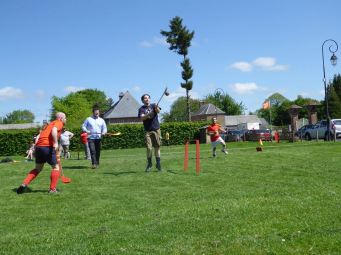
Choule match at Crosse in Normandy [Reference: 5][Picture Credit: Fédération de Jeux et Sports Traditionnels Normande et Vikings]

About

The Fédération de Jeux et Sports Traditionnels Normande et Vikings runs competitons in the Traditional Sports of Normandy (North France) and the Vikings who settled there.

From Wikipedia: “La soule, later choule or sioule, is a traditional team sport that originated in Normandy and Picardy. The ball, called a soule, could be solid or hollow and made of either wood or leather. Leather balls would be filled with hay, bran, horse hair or moss.”

References

[1] Fédération de Jeux et Sports Traditionnels Normande et Vikings (2014) logotradinormandiedetoure [Internet] Available from: https://jeuxtradinormandie.files.wordpress.com/2014/11/logotradinormandiedetoure.png [Accessed 23 October 2020]

[2] Fédération de Jeux et Sports Traditionnels Normande et Vikings (2020) Councours/Championnats (challenges et contest) [CHAMPIONNAT CHOULE CROSSE NORMANDE 2019] [Internet] Available from: http://jeuxtradinormandie.fr/ [Accessed 23 October 2020]

[3] Fédération de Jeux et Sports Traditionnels Normande et Vikings (2020) DESCRIPTIF DES JEUX [Internet] Available from: http://jeuxtradinormandie.fr/ [Accessed 23 October 2020]

[4] Wikipedia (2020) La Soule [Internet] Available from: https://en.wikipedia.org/wiki/La_soule [Accessed 23 October 2020]

Images

[5] Fédération de Jeux et Sports Traditionnels Normande et Vikings (2020) 11181806_668958876542486_2900937163927614507_n [Internet] Available from: https://jeuxtradinormandie.files.wordpress.com/2014/11/11181806_668958876542486_2900937163927614507_n.jpg?w=341&h=256 [Accessed 23 October 2020]

Acknowledgements

Thanks to Dervla Mulcahy & Nora Mulcahy

About this document

Researched, compiled and written by Enda Mulcahy for the

Eirball | Irish North American and World Sports Archive

Last Updated: 23 October 2020

(c) Copyright Enda Mulcahy and Eirball 2020

You may quote this document in part provided that proper acknowledgement is given to the authors. All Rights Reserved.

Cornish Hurling Town v Country Second Saturday After Shrove Tuesday 1950-2005

Winners 1950-2005

Year2nd Saturday Winning TeamWinning Player
1950TownRundle Lawry
1951CountryCyril Lawry
1952CountryCyril Lawry
1953CountryMichael Weldhen
1954TownWill Hawkey
1955CountryDavid Bazeley
1956CountryMichael Weldhen
1957TownTony Hawkey
1958CountryMichael Weldhen
1959TownJack Payne
1960Town Mark Syms
1961CountryMichael Weldhen
1962TownRichard Rundle
1963CountryMichael Weldhen
1964TownRichard Rundle
1965TownRichard Rundle
1966TownGarry Hawken
1967CountryGeoffrey Hawke
1968CountryGeoffrey Hawke
1969CountryAlan Rodliffe
1970CountryMichael Weldhen
1971CountryMichael Weldhen
1972CountryMichael Weldhen
1973TownDavid Green
1974TownDavid Green
1975CountryMike Hitchens
1976CountryMichael Weldhen
1977TownPhilip Tremain
1978CountryMichael Weldhen
1979CountryMichael Weldhen
1980TownRichard Ellery
1981TownTerry Green
1982CountryMichael Weldhen
1983TownSid Bennett
1984TownDavid Rogers
1985TownDavid Chapman
1986CountryRobert Weldhen
1987TownIain Robinson
1988CountryIain Robinson
1989CountryJoel Blake
1990CountryAdam Ellery
1991TownPaul Hitchens
1992CountryAlex Cole
1993TownClint Histon
1994TownMike Hitchens
1995TownAnthony Hawken
1996TownMark Windebank
1997CountryAdam Ellery
1998CountryPhilip Ellery
1999TownNigel Masters
2000TownMark Coleman
2001CountryTom Wakelam
2002TownScott Bennett
2003CountryTom Wakelam
2004TownSean Johns Jnr
2005CountryTom Wakelam

History

Every Shrove Tuesday in St. Columb’s, Cornwall, the game of Hurling is played between ‘Town’ and ‘Country’. The night before resembles a ghost town as all the shops are boarded up and shuttered before the game is played the next day. There are no limits to the numbers of players in the game, with each player playing for either the ‘Town’ or ‘Country’. The game kicks off with the words “Town and Country do your best. but in this parish I must rest.”.

Traditionally, the game was played between the men of St. Columb, but is now played by the children. [3]

The Game can last a few minutes or it can last hours depending on how quickly the winning team can get the ball to the goal. The winning player who carries the ball to the goal has the option of keeping the ball and paying for a new one by a local craftsman. On the 4th March 2003 Sean Johns won it for the ‘Town’, his third time winning it. In 2002 Scot Bennett became the youngest ever winner, at 11-years-of-age. After the match is over another tradition is partaken , when the silver ball is dipped in the winners drink. [1]

The ball is constructed traditionally, out of silver with an applewood core, taken from a local orchard.

References

________________________________________________________

Websites

[1] BBC Cornwall (2003) Hurling at St. columb in the 21st Century [Internet] Available from; http://www.bbc.co.uk/cornwall/villages/stories/stcolumb_hurling.shtml [Accessed 7 March 2018]

[2] The Beehive | Internet Archive (2006) Hurling Winners 1950-2005 [Internet] Available from: https://web.archive.org/web/20060218093026/http://beehive.thisiscornwall.co.uk/default.asp?WCI=SiteHome&ID=661&PageID=73544 [Accessed 13 June 2019]

[3] St. Ives Web Community TV (2013) The St. Ives Feast and the Silver Ball [Internet] Available from: https://web.archive.org/web/20130819100810/http://stivestv.co.uk/whatson/feast_day_2013.htm [Accessed 13 June 2019]

Acknowledgements

Thanks to Ciaran Columb.

About this document

Researched, compiled and written by Enda Mulcahy for the

Eirball | Irish North American & World Sports Archive

Last Updated: 15 July 2020

(c) Copyright Enda Mulcahy and Eirball 2019-2020

You are may quote this document in part provided that proper acknowledgement is given to the authors. All Rights Reserved.

Manx Cammag | North v South on St. Stephen’s Day

Results

YearWinnersRunners-Up
2015North7South1

About

Manx Cammag is a version of Hurling (or Caman in Irish) played in the Isle of Man, where Manx Gaelic was traditionally spoken. It is also very similar to the Scottish game of Shinty or Camanachd.

The earliest mention of Hurling or Caman is in the Irish ‘Book of Leinster’ in the 12th Century AD. It played with a small ball and hooked stick.

Kit Gawne, writing in his book, ‘Isle of Man Hockey’ suggests the game may have been introduced by missionaries, although the earliest mention in the Isle of Man records is not until 1760.

It is a Winter Sport, with special matches arranged on St. Stephen’s Day (such as the one between North & South of the Island.

There are few rules, and any number of players can play on either side, with coats or sticks marking goalposts.

The match on St. Stephen’s Day between North & South is played in conjunction with the Festivities associated with the day, such as ‘Hunting the Wren’, although these days no wren is killed, and those making donations to charity are given a coloured ribbon, rather than a wren’s feather, supposed to bring good luck for the following year, thought to be particularly efficacious in the event of a shipwreck or witchcraft.

Reference:

Websites:

[1] North American Manx Association (2015) “Rain doesn’t stop play on St. Stephen’s Day” [Internat] Available from: http://namanx.org/rain-doesnt-stop-play-on-st-stephens-day-2 [Accessed 5 March 2017]

[2] isleofman.com (2017) “Work off your Christmas Turkey with a game of Cammag!” [Internet] Available from: https://www.isleofman.com/lifestyle/health-sports/cammag/ [Accessed 13 October 2017]

Acknowledgements:

Thanks to Stephen Fitzpatrick & John Doody

About this document

Researched, Compiled and Written by Enda Mulcahy for the

Eirball | GAA World Archive

Last Updated: 16 May 2019

(c) Copyright Enda Mulcahy and Eirball 2019

You may quote this document in part provided that proper acknowledgement is given to the authors. All Rights Reserved.

Cornish Hurling Town v Country Shrove Tuesday at St. Columb 1950-2005

Winners 1950-2005

YearShrove Tuesday Winning TeamWinning Player
1950CountryDenis Ellery
1951TownDesmond Stephens
1952TownPat Morris
1953CountryTony Williams
1954TownGeorge Roseveare
1955CountryGraham Wills
1956TownTony Hawkey
1957CountryMichael Weldhen
1958CountryMichael Weldhen
1959TownIvan Smith
1960CountryMichael Weldhen
1961TownTony Hawkey
1962TownMichael Tabb
1963Town & CountryLost Ball !
1964TownGary Hawken
1965CountryMichael Weldhen
1966TownRichard Rundle
1967TownIvan Smith
1968Town David Green
1969CountryMichael Weldhen
1970TownAllan Chapman
1971TownGeoffrey Cole
1972CountryMichael Weldhen
1973TownDavid Osborne
1974CountryRobert Weldhen
1975CountryRobert Weldhen
1976CountryRobert Weldhen
1977TownMike Hitchens
1978TownBrian Hellings
1979TownTony Parkin
1980TownTony Parkin
1981TownBill Scott
1982TownStuart Nicholas
1983TownDarren Austerfield
1984CountryRobert Weldhen
1985TownBill Scott
1986TownIain Robinson
1987TownDavid Rogers
1988CountryRobert Weldhen
1989CountryRundle Weldhen
1990CountrySean Johns
1991CountryRobert Weldhen
1992CountryRobert Weldhen
1993TownSid Bennett
1994TownMark Windebank
1995CountryPhilip Ellery
1996CountryAlex Cole
1997TownJamie Lomax
1998TownDarren Hawkey
1999TownSean Johns
2000TownMark Coleman
2001TownMark Coleman
2002TownPhil Morris
2003TownSean Johns
2004TownNick Gregory
2005CountryAdam Ellery

History

___________________________________________________________

Every Shrove Tuesday in St. Columb’s, Cornwall, the game of Hurling is played between ‘Town’ and ‘Country’. The night before resembles a ghost town as all the shops are boarded up and shuttered before the game is played the next day. There are no limits to the numbers of players in the game, with each player playing for either the ‘Town’ or ‘Country’. The game kicks off with the words “Town and Country do your best. but in this parish I must rest.”.

Traditionally, the game was played between the men of St. Columb, but is now played by the children. [3]

The Game can last a few minutes or it can last hours depending on how quickly the winning team can get the ball to the goal. The winning player who carries the ball to the goal has the option of keeping the ball and paying for a new one by a local craftsman. On the 4th March 2003 Sean Johns won it for the ‘Town’, his third time winning it. In 2002 Scot Bennett became the youngest ever winner, at 11-years-of-age. After the match is over another tradition is partaken , when the silver ball is dipped in the winners drink. [1]

The ball is constructed traditionally, out of silver with an applewood core, taken from a local orchard.

References

________________________________________________________

Websites

[1] BBC Cornwall (2003) Hurling at St. columb in the 21st Century [Internet] Available from; http://www.bbc.co.uk/cornwall/villages/stories/stcolumb_hurling.shtml [Accessed 7 March 2018]

[2] The Beehive | Internet Archive (2006) Hurling Winners 1950-2005 [Internet] Available from: https://web.archive.org/web/20060218093026/http://beehive.thisiscornwall.co.uk/default.asp?WCI=SiteHome&ID=661&PageID=73544 [Accessed 13 June 2019]

[3] St. Ives Web Community TV (2013) The St. Ives Feast and the Silver Ball [Internet] Available from: https://web.archive.org/web/20130819100810/http://stivestv.co.uk/whatson/feast_day_2013.htm [Accessed 13 June 2019]

Acknowledgements

Thanks to Ciaran Columb.

About this document

Researched, compiled and written by Enda Mulcahy for the

Eirball | Irish North American & World Sports Archive

Last Updated: 16 July 2020

(c) Copyright Enda Mulcahy and Eirball 2019-2020

You are may quote this document in part provided that proper acknowledgement is given to the authors. All Rights Reserved.